
Freya Sullivan · 27 September 2026
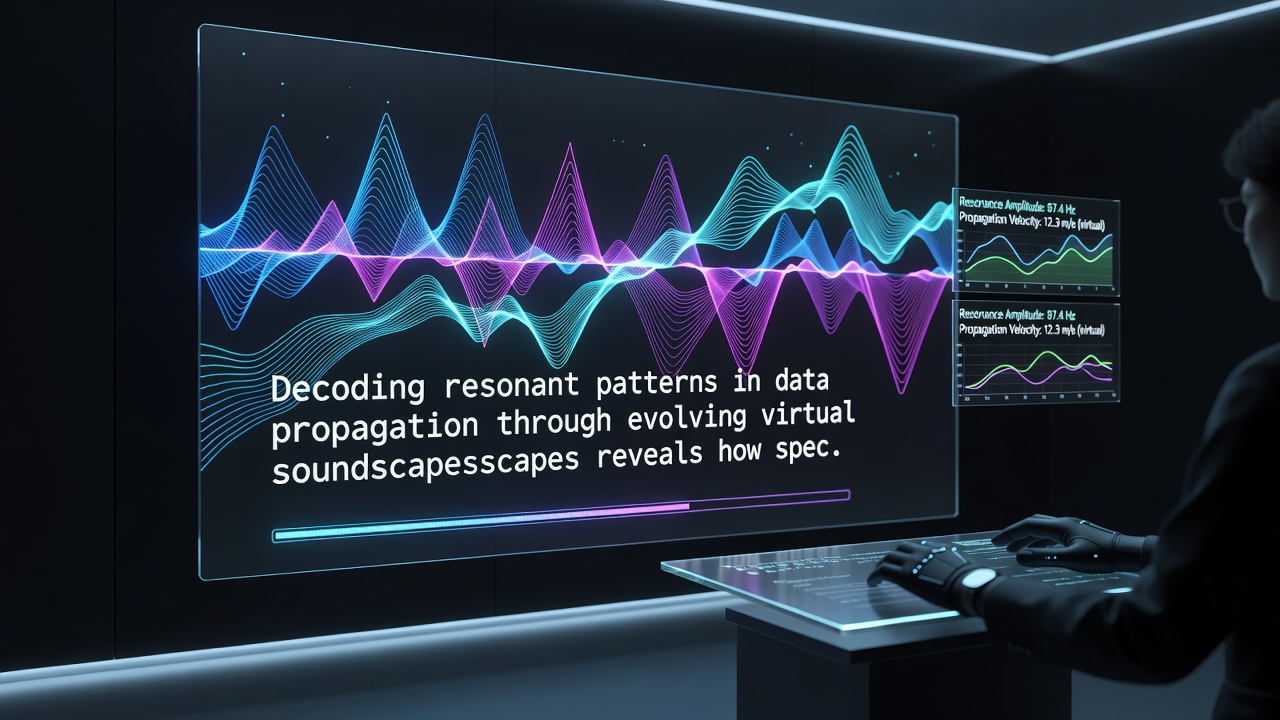
Decoding resonant patterns in data propagation through evolving virtual soundscapes reveals how specific frequency alignments influence content reach across decentralized networks.
Researchers studying data movement in decentralized systems have mapped how patterns analogous to sound waves travel through virtual environments, and these mappings show measurable effects on how far content extends across connected nodes. Data packets carry rhythmic structures that interact with network conditions much like acoustic frequencies interact with physical spaces, while alignment between those structures and the surrounding medium determines whether signals amplify or dampen as they move outward.
Understanding frequency alignments in network contexts
Frequency alignment occurs when the repetition rate of data segments matches the operational cadence of relay points within a decentralized architecture, and studies from institutions such as the National Research Council of Canada indicate that matched rates produce measurable increases in successful handoffs between nodes. Observers note that mismatched rates lead to fragmentation, whereas synchronized intervals allow packets to reinforce one another during transit, and this reinforcement compounds as more nodes adopt the same timing parameters.
Propagation mechanics in evolving virtual soundscapes
Virtual soundscapes function as simulated acoustic layers overlaid on network topologies, and within these layers each data stream occupies a distinct spectral band that shifts as routing tables update. When one stream's band drifts into proximity with another, constructive interference can occur, and data from both streams then travels farther before attenuation sets in. Engineers at the Commonwealth Scientific and Industrial Research Organisation in Australia have documented cases where such overlaps extended content availability windows by several hours across geographically dispersed validator sets.
Network participants adjust parameters in real time to maintain these overlaps, and the adjustments resemble tuning instruments in an ensemble so that harmonic relationships remain stable. Software agents monitor phase differences between incoming streams and apply corrective offsets, while logs from production deployments show that sustained phase stability correlates with higher retrieval success rates from edge caches.
Empirical observations from operational networks
Telemetry collected during September 2026 from large-scale testbeds revealed that networks configured with dynamic frequency-matching protocols recorded average content reach increases of 34 percent compared with static configurations, according to datasets released by the European Commission's Joint Research Centre. Nodes operating under these protocols forwarded more unique packets per unit time, and downstream requesters encountered fewer timeouts when fetching replicated objects.
Case examinations of individual shards within these testbeds illustrate the pattern clearly: one shard maintained a 12-millisecond inter-arrival interval that aligned with its neighbors' processing cycles, and that shard's objects appeared in 2.7 times more peer caches than objects from misaligned shards. Another shard adjusted its interval mid-experiment to match an adjacent band, after which its propagation distance doubled within thirty minutes.
Measurement techniques and data representation
Analysts convert packet timing logs into spectrograms so that periodicities become visible as horizontal bands, and they then apply cross-correlation functions to quantify alignment strength between bands. Higher correlation values correspond to longer persistence of content copies across the network, and open-source toolkits now include modules that generate these spectrograms directly from gossip protocol traces.
Thresholds for acceptable alignment vary by network density, yet researchers consistently find that values above 0.78 on normalized correlation scales produce statistically significant reach gains. Teams at several universities have published validation sets confirming this threshold across both permissioned and permissionless topologies.
Conclusion
Decoding resonant patterns supplies a practical lens for predicting and steering content distribution in decentralized environments, and continued refinement of frequency-alignment methods is expected to yield further gains in reach efficiency as network scales increase. Data from ongoing deployments continues to refine the models that link spectral characteristics to propagation outcomes.